Showing posts with label baking. Show all posts

Sunday, December 27, 2009

Baking Brownies, Um, I mean Chocolate Cake

I make brownies every now and again. It's the recipe from the Joy of Cooking by Irma Rombauer and Marion Rombauer Becker. It is my favourite recipe because it is simple and produces excellent results with very little effort. The only problem I have with it is that I lack nerve and therefore I fail every once in a while to pull the tray out of the oven in time (in my oven that usually means 20 minutes) when I use the usual (6" by 9") heavy pan I have.

If everything goes as planned in the preparation, and I do remember to keep an eye on the clock then I usually manage to steel myself and turn the oven off on time so that I get the brownies I prefer: slightly fudgy and extremely chocolate-ly (thanks in no small measure to substituting Van Houten's cocoa powder for cooking chocolate mixed into the flour. Van Houten's cocoa also happens to be remarkably cost-effective and I have yet to taste better results from any other chocolate or cocoa).

For anyone who has never baked brownies, but has tried baking cakes, the reason why this is unnerving is that brownies are best taken out when still not quite cooked which means the skewer test does not work unlike with cakes. It seems as if one is not fully cooking the batter and one will end up with partially cooked batter instead of squidgy brownies. Usually I manage to resist the pressure to leave it in longer and get my preferred result.

However, this time, I lost my nerve again because instead of consulting the recipe and going by the book, I decided to wing it and see I could remember the recipe. I did. I managed to remember all the ingredients and weighed them all out accurately. I managed to remember that half a cup of butter meant 4 ounces of butter duly melted in the microwave. And so on. The only thing I did different was the sequence in which I usually put in the ingredients. I reversed the usual sequence of mixing in the cocoa-flour mixture and the melted butter. The result: the batter ended up looking and tasting remarkably like chocolate butter cream. It usually looks a lot darker and has a stiffer consistency.

So instead of baking it for the usual 20 minutes at 180 C, I ended up leaving it in for 25 minutes and turned off the over and left it in for another 10 minutes. To those of you who are wondering how on earth I managed to make the logical leap to conclude that baking it longer will cure the batter of this error, I can only say, I thought that since it was more creamy than it was supposed to be, I should bake it longer as it would be impossibly smudgy otherwise.

The result: chocolate cake. It doesn't taste bad at all. It's a decent chocolate cake. But it is not a pan of brownies. I shall now have to rescue it by mashing raspberries and serving that along side the cake to make up for that. That of course is simply an excuse for eating up the glorious tangy raspberries with chocolate, one of my favourite ways of eating chocolate.

Sunday, January 25, 2009

A Slice of Pannettone


A Slice of Pannettone
All Rights Reserved
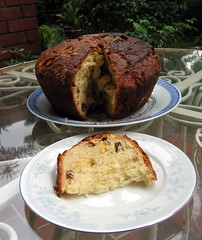
I got into baking mode late in 2008 due to my little thumb injury. However once I got going, I did get a bit adventurous and decided it was worth trying to bake bread again.

As you can see from the picture above, I baked the Italian festive bread: a pannettone. I baked it old fashioned style ie without the commercial high fluted pannettone moulds that give it its characteristic shape and incredible lightness. Since I lacked that mould, I simply used whatever came to hand in my kitchen which is pretty much how your average Italian housewife would have done it before the advent of that famous mould and the commercially baked ones.

The result: a flatter, slightly more dense bread but still a great texture and taste with the little orange peel bits and zest. I also ran out of lemons so no lemon zest but being it still worked very well with orange substitute. It does take a while as most breads do with 2 risings but is otherwise reasonably easy to make and very rewarding to eat. The rapidity with which the two pannetones disappeared was clear testament to its tastiness.

Tuesday, April 15, 2008

Chocolate Chip Peanut Butter Cookies


My nephews, all four, aged from 2+ to 9, actually baked these soft American style cookies and very nicely brought over a plateful, all nice and warm still from the oven. They were beautifully moist and the chocolate still half melted from the heat of the oven. Absolutely perfect in texture and taste so I immediately scoffed four and had to move the plate out of my own reach lest I eat the rest.

The flower is not edible just in case anyone was wondering.

Wednesday, March 26, 2008

Gubana


I'd been wanting to do something special to mark Easter Sunday other than attending the Easter Vigil mass. So this year I decided to bake an Italian Easter bread called Gubana. Gubana is from a region east of Venice called Friuli, near the what used to be Yugoslav and Austrian borders. It's a briochelike dough rolled up like a strudel with a nut and dried fruit filling and twisted itself around like a snail then baked.

The recipe I used came from a book by Carol Field called "The Italian Baker". It's an excellent book and I've had good results from recipes I've tried in the past. And twisted doughs have always appealed to my inner aesthetic cook. So out I went on holy Saturday morning with my shopping list of ingredients.

As our domestic helper is always wanting to learn things new in the kitchen I decided she could do the dough and I would do the filling and walk her through the process. So I showed her the recipe and told her she could either use the electric mixer or knead it with her hands. She chose the mixer with the dough kneaders.

The process took the whole afternoon but of course much of that time was spent doing other things while waiting for the risings to take place. The fruit (mainly rasins and candied peel and lemon zest) and nuts (walnuts, hazelnuts) was mixed with a mixture of different liqueors and spirits so it tasted wonderful on its own. The filling was spread on the rolled out dough rather like spreading jam onto a swiss roll and then rolled up. The additional step was then to roll up again to form a round snail, wait for it to rise again then pop it in to bake in the oven.

The result was great when freshly baked but I was on the whole a bit disappointed with what it tasted like the next day. It was nice enough, but nothing to rave about. The fruit filling while it tasted great before being baked lost a lot of its nuance afterwards so I'd personally adjust the recipe to include more raisins and more liqueor.

As it doesn't have any artificial preservatives, it doesn't retain its freshness well although it keeps so it greatly benefits from toasting from the next day onwards. I felt that while it tasted nice enough, it could have been kneaded more to create a greater elasticity in the final bread plus maybe bread flour rather than all purpose flour would also help to that end. But it is actually meant to be a dense bread, so maybe the texture wasn't wrong, just that I prefer my bread slightly softer although I still like chewy textures. However while I grumble, you may notice that the only picture I managed to take is on the second day when most of the bread had already been eaten or given away. So it was certainly edible enough to get eaten fairly quickly and distracting enough for me to forget to photograph it freshly baked.

Overall verdict: interesting but not rave-worthy

Monday, March 24, 2008

Syllabic Verse Exercise

The next exercise in poetry was to write simple stanzas with pre-set numbers of syllables each. This form of poetry focuses on the number of syllables regardless of the number of stresses. It's not too common in English poetry because English is more of a stressed language than eg Japanese or Chinese where syllabic poems are far more common.


On Rain:

I saw my brother run once
Down the slope near home
I was driving up the slope and
Wondering why he ran

Then just behind him, a sheet
Of rain I saw. Light
But growing strong. It followed
Him to the door. Slam!


Hygiene:

Hygiene counts
When baking bread: no ants,
Birds,
Are allowed in
The kitchen while it's done.
At least during
Which
One's hands especially
Are washed, dried.

Kneading means
Wet, sticky, doughy hands.
But
Later this turns
A drier dough which springs back at
A gentle prod
So
Then we rest it and clean
Hands and wait.


As you can see, I was contemplating the process of baking as I had planned to bake an Italian Easter bread called Gubena so it seems more interesting to slant the poem in that direction. For those who are interested in the outcome of the baking, stay tuned.